

Summary
Quick Overview
With over 75% of people more likely to open an SMS than an email, enterprise text messaging has become crucial for operational communications. But choosing the wrong platform can create compliance issues, scalability problems, and workflow headaches. This guide provides a four-step framework to help IT directors, operations managers, and procurement teams select the right enterprise SMS solution. Learn how to identify your primary use case, evaluate essential features like API integration and multi-tier administration, navigate compliance requirements including 10DLC registration, and understand pricing structures that scale with your organization. CompleteSMS offers unlimited users, managed compliance support, and seamless integration with your existing tools. Request a demo to see how enterprise-scale text messaging can streamline your workflows.
Choosing an enterprise texting solution is an organizational infrastructure decision, not a simple software purchase. Over 75% of people are more inclined to open an SMS message than an email, which is why large organizations are prioritizing the channel for operational communications. The catch? The wrong enterprise SMS platform can create compliance headaches, limit scalability and leave departments with workflows that don’t quite work.
So, how do you choose the right fit? This guide walks through a four-step framework to help IT directors, operations managers and procurement leads make a confident platform decision.
Step 1: Identify Your Primary Enterprise Use Case
Evaluating platforms without first aligning on the primary use case might cause some problems in enterprise SMS procurement. A platform that excels at high-volume IT alerting may not fit a team that needs two-way conversational messaging. Start by mapping your dominant communication workflow.
Core enterprise use cases include:
- Automated operational alerts: These include two-factor authentication (2FA) codes, system notifications when databases or websites go down and IoT-triggered messages that alert technical teams to equipment failures.
- Mass workforce communications: HR shift updates, emergency alerts, and company-wide announcements rely on bulk messaging capabilities that can reach hundreds or thousands of employees simultaneously.
- Two-way support: This enables real-time conversation that lets recipients reply directly to questions, confirmations or status updates.
- Cross-department coordination: IT, HR, operations and customer service teams can deploy SMS independently while maintaining centralized oversight.
Identifying the dominant use case up front narrows platform criteria significantly and prevents purchasing a tool that doesn’t align with deployment needs.
Step 2: Look for These Essential Enterprise SMS Features
Enterprise SMS platforms need to be able to handle multiple sending user/administration types, administrative oversight and API-level automation simultaneously. Consumer-grade tools can’t do this at an organizational scale.
Scalability and User Management Controls
Enterprise organizations do not stay the same size—and neither does their communications infrastructure. Evaluate these scalability criteria:
- Unlimited user seats eliminate per-user pricing that punishes organizational growth.
- Multi-tier administration provides granular role permissions that determine who can send, to which contact lists and with which templates.
- Cost center capabilities separate departmental usage for internal billing.
- Message volume controls prevent individual users from creating compliance liability.
Role-based access, administrative hierarchy and cost allocation are the criteria enterprise IT and procurement teams should prioritize.
API Access and Developer Flexibility
For any enterprise with an existing tech stack—CRM, ERP, HR management systems, helpdesk platforms—API integration is the bridge between SMS and the rest of the infrastructure. The ideal enterprise messaging software plugs into existing tools rather than requiring a new workflow:
- Simple Mail Transfer Protocol (SMTP) and HTTPS API support: Look for industry-standard protocols that connect to existing enterprise systems.
- Quality developer documentation: Ensure the platform provides clear technical guides that reduce implementation time.
- Single and bulk send support: The API should handle individual messages and mass notifications.
Reliable Delivery Across Regions and Networks
Message delivery is nonnegotiable for enterprise communications. A failed 2FA message, a missed emergency alert or a blocked HR notification has operational consequences. What separates reliable from unreliable platforms:
- Multi-aggregator routing: CompleteSMS routes through multiple down-stream partners. This ensures delivery even when one carrier experiences outages.
- Global delivery capability: Including access to local phone numbers in many countries.
- Delivery status reporting: IT teams can confirm delivery and view any errors.
- Dedicated numbers: These establish a consistent sender identity so recipients recognize who’s texting them.
- Call forwarding: This feature routes inbound calls from dedicated messaging numbers to an office or cell number. This helps teams respond when recipients choose to call instead of text.
Step 3: Evaluate Compliance and Deliverability Requirements
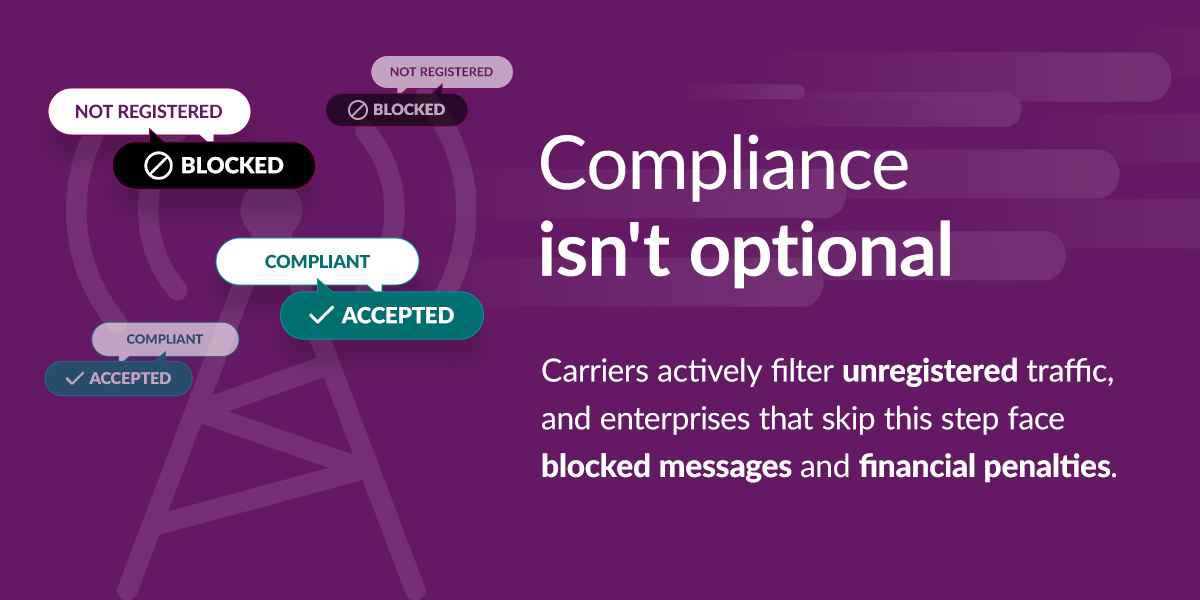
Compliance registration isn’t optional in many countries. Carriers actively filter unregistered traffic, and enterprises that skip this step face blocked messages and financial penalties.
Any organization sending application-to-person (A2P) SMS in the United States must register its brand and messaging use case with the carriers through their messaging provider. This applies to all business SMS—not just bulk or high-volume sends. Registration will include all business entity details, from tax ID to support phone number, and then why and what you’re sending and to whom.
CTIA guidelines govern consent management and operational compliance. Key requirements are:
- Consent management: Platforms must support opt-in requirements that ensure recipients have agreed to receive messages.
- Opt-out handling: Look for STOP keyword support and automatic blacklisting.
- Platform-managed compliance: Select a platform that actively manages obligations rather than leaving it entirely to the sender.
Australian enterprises should reference the Australian Communications and Media Authority (ACMA) compliance as the parallel regulatory framework.
The key vendor evaluation question is—does the SMS provider manage registration on your behalf? A provider that handles registration reduces the compliance burden on IT and legal teams.
Step 4: Understand Enterprise SMS Pricing Structures
Pricing models vary widely, and the wrong structure can become costly. Common pricing models include:
- Token-based models: The platform is included when the organization purchases SMS tokens, so messaging costs are tied to volume rather than to user seats.
- Per-user pricing: This model is typical in small-to-medium business (SMB)-focused tools, but can become expensive when rolling out a corporate text messaging platform to hundreds of employees.
- Volume-tiered pricing: This allows large organizations to negotiate at scale.
For large organizations, unlimited-user models with token or credit-based messaging are generally more cost-effective than per-seat models. Cost center capabilities allow enterprises to allocate messaging costs by department for internal accountability when choosing an enterprise SMS provider.
Frequently Asked Questions About Enterprise Text Messaging Solutions
Enterprise buyers evaluating platforms at this stage often have questions.
What Is the Difference Between Enterprise SMS and Standard Business Texting?
Scale, governance and compliance are what set enterprise SMS apart from standard business texting. Enterprise SMS platforms support multi-department deployments with administrative controls, API integration and compliance management that standard SMB texting tools don’t always offer. Best enterprise SMS solutions handle hundreds of users, automation and regulatory obligations simultaneously.
Do I Need to Register for 10DLC Before Sending Enterprise SMS in the U.S.?
Yes. Any organization sending A2P SMS via a 10-digit local number in the United States must register their brand and messaging use case through 10DLC registration. This applies regardless of message volume—it’s a universal requirement for enterprise texting solutions.
Can Enterprise SMS Platforms Integrate With Existing Business Software?
Many enterprise SMS platforms can integrate with existing business software. Look for SMTP and HTTPS API support that allows existing applications to automatically trigger SMS. The platform should work within your infrastructure. SMS API capabilities are an example of what integration-ready enterprise texting solutions for large-scale growth look like.
How Does Enterprise SMS Pricing Typically Work?
SMS pricing models vary. Credit-based models are common for operational SMS, where the platform is included when credits or tokens are purchased. Per-user pricing is typical in SMB tools but can become expensive at enterprise scale. Look for unlimited user models, like CompleteSMS, with volume-based credit pricing for cost efficiency.
What Compliance Requirements Apply to Enterprise Text Messaging?
In the United States, 10DLC registration is required for A2P messaging. CTIA guidelines govern consent, opt-in and opt-out management. Australian organizations should reference ACMA guidelines when sending with a custom sender ID. Compliance is a critical filter when deciding on an enterprise SMS software. All countries have different requirements, your SMS software should be able to guide you though them.
How CompleteSMS Supports Enterprise-Scale Text Messaging
CompleteSMS is built for the operational complexity that enterprises actually face. Key platform capabilities include:
- Multi-tier administration: This provides granular control over user permissions, message volumes and department-level cost visibility.
- Managed 10DLC registration: CompleteSMS helps manage the registration process, reducing administrative lift while your organization maintains required consent, opt-in and opt-out practices.
- Unlimited users: This eliminates per-seat cost penalties as your organization grows.
- Built-in redundancy: multiple global delivery networks ensure messages reach recipients even when individual carriers experience outages.
- Developer-ready SMS API: This integrates with existing workflows like CRM platforms, help desk systems and HR management tools.
- Dedicated numbers and call forwarding: These numbers establish sender identity and route inbound replies to appropriate team members.
CompleteSMS also plugs directly into the tools your teams already use—Gmail, Outlook or the CompleteSMS web portal. With over 25 years in business, CompleteSMS has extensive experience supporting enterprise SMS solutions and helping organizations increase operational efficiency through streamlined text messaging workflows.
Request a Demo With CompleteSMS
Selecting the right enterprise SMS platform comes down to seeing how it operates in your environment. Request a demo with CompleteSMS to explore how multi-tier administration, built-in compliance support and integration with your existing workflows can simplify enterprise-scale text messaging for your organization.