

Summary
Quick Overview
Australia has strict SMS regulations to both combat spam and protect consumer privacy. The Spam Act 2003, Privacy Act 1988, and recent industry updates require businesses to obtain proper consent, clearly identify themselves, and provide easy opt-out options in every commercial text message. This guide walks you through the three main regulatory acts, explains consent requirements, and shares practical tips to keep your messages compliant. With penalties reaching up to $50 million for businesses, understanding these rules is cruicial. CompleteSMS helps you navigate Australian compliance effortlessly while maintaining strong customer relationships.
Like many other countries, Australia imposes clear, stringent regulations to prevent and manage spam in short message service (SMS) communications. We can all agree that spam messages are a nuisance. To optimize your customers’ experience, it’s important to limit these messages as much as possible.
Understanding and adhering to Australian regulations for SMS is crucial to any successful SMS campaign. To help you out, we crafted this guide to cover all the bases of SMS compliance in Australia. We’ll also lend some handy tips to prevent your business’s messages from being classified as spam.
Who Oversees Australian SMS Regulations?
When texting in Australia, keep in mind that the country operates under specific regulatory bodies and frameworks. Three main regulatory acts oversee SMS campaigns and data collection practices in Australia:
1. Privacy Act 1988
While the Privacy Act 1988 doesn’t specifically call out SMS marketing laws in Australia, its principles still apply. As the country’s primary set of data privacy laws—enforced by the Office of the Australian Information Commissioner (OAIC)—it dictates how organizations handle users’ personal information. In a nutshell, it ensures the information’s accuracy and integrity are maintained, and it states that every user has an inviolable right to privacy.
The Privacy Act 1988 bases its regulations on the 13 Australian Privacy Principles, which govern the rights and obligations around these key criteria:
- The collection, use and disclosure of users’ personal information
- Individuals’ inherent right to access their personal information
- Integrity and correction of personal information
- How agencies and organizations are held accountable for data breaches
The Australian Privacy Principles are considered principles-based law. That means organizations have some freedom in tailoring their personal information handling protocols to their unique business models and users’ needs. And, because these principles are technology-neutral, they adapt and evolve with changing technologies.
When it comes to SMS messaging in Australia, the Privacy Act 1988 requires businesses to obtain consent from users before collecting their mobile phone numbers and any other personal information. They also need to disclose why they’re collecting said data. Overall, the goal is to promote transparency and accountability in data collection practices.
A breach of one of the Australian Privacy Principles is considered an “interference with an individual’s privacy,” and as such, an organization can find itself tied up in some legal trouble. The OAIC has the authority to perform investigations and penalize businesses that violate it.
2. Spam Act 2003
The Spam Act 2003 is an Australian law that aims to reduce unsolicited commercial electronic messages, which most of us refer to as spam. It applies to several forms of electronic communication, including SMS. “Commercial electronic messages” are those meant to advertise and promote products and services.
Like the Privacy Act 1988, the Spam Act 2003 emphasizes the importance of user consent. It also outlines specific definitions for different forms of consent:
- Express consent: The user directly gives their permission to receive messages through a conscious action, such as submitting an online form, checking a box or responding to a text message with a keyword.
- Inferred consent: With this type of consent, you can reasonably assume the recipient has consented based on their previous actions. For instance, let’s say a user provides their phone number when signing up for a service or purchasing a product. You might infer consent to send them messages regarding that service or product.
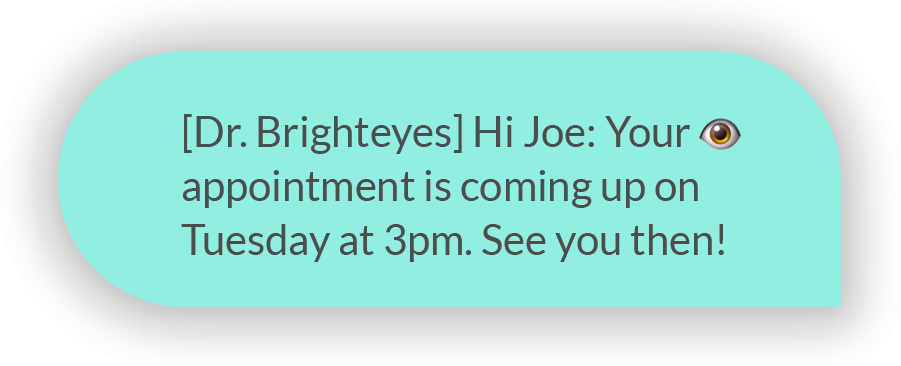
The Spam Act requires senders to identify themselves clearly to the recipient, such as stating their business name. Also, they must give recipients an easy option to unsubscribe from receiving messages.
There are some exemptions to the Spam Act, including messages sent by government bodies, like national emergency alerts, and messages that are purely factual and not commercial in nature.
The Australian Communications and Media Authority (ACMA) enforces the Spam Act 2003. It can penalize organizations that violate these regulations, including investigating complaints, issuing fines and taking legal action.
3. Spam Regulations 2021
These regulations came into effect in April 2021 as an addition to the Spam Act 2003. The amendment was passed due to users’ increasing frustration toward unnecessarily complex opt-out processes.
The goal of this update was to simplify the process of unsubscribing from electronic marketing messages, making it more accessible. It clarifies that opt-out functions cannot require users to:
- Provide personal information, besides the electronic address to which the message was sent.
- Create or log into an account.
- Use a premium service.
- Pay any fees.
With this relatively recent update, it certainly can’t hurt for businesses to review their unsubscribe processes against these regulations to make sure they’re compliant.
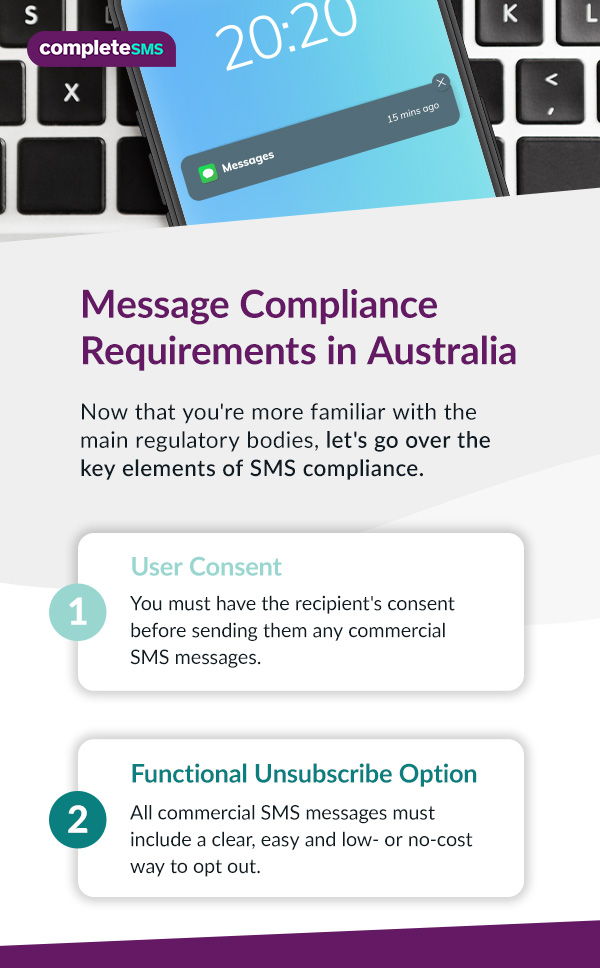
Message Compliance Requirements in Australia
Now that you’re more familiar with the main regulatory bodies, let’s go over the key elements of SMS compliance.
1. User Consent
You must have the recipient’s consent before sending them any commercial SMS messages. Consent can be:
- Express: The person actively gives the business permission to message them, by way of filling out a form, checking a box, entering into a verbal agreement or something similar.
- Inferred: In some situations, the existing relationship between the person implies consent, such as a customer who bought a product with ongoing service or a warranty.
2. Functional Unsubscribe Option
All commercial SMS messages must include a clear, easy and low- or no-cost way to opt out. The most common way to do this is to include “Reply STOP to opt out.” You must process all opt-out requests within five business days and the unsubscribe facility must be functional for 30 days after the SMS is sent.
Other Tips for SMS Compliance and Spam Avoidance
In addition to complying with the basic regulations for sending a business text message in Australia—such as obtaining express consent, identifying your company and including clear opt-out instructions—below are some other best practices to keep your messages from being flagged as spam. By following these tips, you can reduce your risk of regulatory compliance violations while maintaining positive relationships with your customers.
1. Limit How Often You Send Messages
When sending a text in Australia—or any other country, for that matter—one of the last things you want is to overwhelm your subscribers with an influx of messages.
Set a reasonable sending frequency and schedule, and stick to it. For example, you might keep it to one or two messages per week, or four or five messages per month. This approach helps prevent your customers from feeling annoyed or overwhelmed to the point of opting out.
On the other side of the coin, consistency is key. When sent with a reasonable frequency, regular promotional messages can help keep customers engaged, giving them exciting offerings to look forward to.
2. Offer Valuable Content
Every message you send should provide value to your customers. Make the content meaningful, whether it’s a personalized message, an important update or an exclusive offer that’s simply impossible to pass up. Recipients are less likely to ignore or delete messages with valuable, relevant content.
Also, make sure you clearly state the purpose of your message, whether it’s advertising a special offer, reminding a customer about an upcoming appointment or sharing a news update about your business.

3. Note Sending Times
When texting Australian numbers, be mindful of recipients’ time zones—Australia does have three different ones, after all. Try to avoid sending messages during inconvenient hours, like late at night or super early in the morning. Being considerate of your subscribers’ time zones and sending messages to accommodate them can help you avoid needless aggravation and complaints.
4. Respond to Opt-Out Requests Efficiently
Establish a process for handling opt-out requests quickly and effectively. Make sure you remove these individuals from your SMS list as soon as possible. For instance, your SMS portal might automatically block sending functions to users who have unsubscribed. Your messaging software, should manage these opt-outs for you, by recording them and blocking any messages accidentally sent in the future. If the recipient wants to again receive the messages, they can reply JOIN to be removed from the opt-out list.
5. Keep Detailed Records of User Consent
Maintain records of how and when you obtained express consent from every recipient, paper or digital. These records could come in handy in case you ever need to demonstrate compliance for any reason.
6. Prioritize Training and Auditing
Training your marketing team on all promotional aspects of your business is essential, and SMS communications are no exception. Educate staff on SMS regulations, as well as your company’s specific compliance policies, to prevent inadvertent violations.
Additionally, conduct regular audits of your SMS practices to ensure continuous compliance. Review your campaigns periodically and compare them against any updates to the Spam Act or ACMA’s guidelines.
7. Choose a Reliable SMS Platform
Select a trusted, reputable SMS platform with built-in compliance features for data transparency and opt-outs, such as unsubscribe handling and consent management. Doing so can streamline user consent processes immensely.
8. Establish a Clear Privacy Policy
Ensure you have a comprehensive privacy policy that outlines how you collect, use and safeguard users’ personal information, including phone numbers. Make this policy easily accessible through your business’s website.
9. Register Your Sender ID
While you’re not required to have a sender ID in order to send SMS messages, for businesses that do wish to use it, the rules for sender IDs have changed slightly since July 1, 2026. Branded or alphanumeric sender IDs must be registered on the ACMA’s SMS Sender ID Register. Unregistered sender IDs are automatically replaced with the word “Unverified” and won’t appear as a stand-alone message. Instead, they’ll appear in a long thread with other unverified messages, so they risk getting lost.
Penalties Associated With Noncompliance
The consequences for violating the Privacy Act 1988 and the Spam Act 2003 are a bit more than a slap on the wrist. Fines can be significant, reaching up to $2.5 million for individuals and $50 million for businesses, or 30% of the sales accumulated throughout the violation.
More severe violations involving large amounts of data and repeat offenses can increase these fines, and the ACMA could take legal action. In addition, the organization may be required to undergo audits and implement stricter compliance programs to remedy its practices. For less severe breaches, the ACMA may issue infringement notices with lower fines. Fees can vary widely based on the severity and nature of the violation.
Beyond financial and legal penalties, compliance issues can hinder a business’s reputation and its customers’ trust. As such, understanding and following these regulations is paramount.
FAQs
We’ve answered some other common questions about best SMS practices in Australia.
1. How Do I Measure SMS Compliance Effectiveness?
A few key performance indicators (KPIs) can reveal if your compliance efforts are working:
- Low unsubscribe rates compared to industry standards
- Little to no customer complaints about SMS communications
- High engagement rates with messages
- Clean audit trails for SMS activities
- Positive feedback from users about SMS practices
2. How Long Should SMS Messages Be?
Try to limit text messages to a maximum of 160 characters. This keeps messages concise, clear and cost-effective, any message over 160 characters could deliver in multiple parts or be considered TLDR.
3. How Much Does It Cost to Register a Sender ID in Australia?
Since 1 July 2026 the ACMA charges $1 per registered sender ID, most providers pass through that cost, and also require a service fee for the set-up of a sender ID with the ACMA.
4. What Are the Penalties for Noncompliant SMS in Australia?
Under the Spam Act 2003, the ACMA can take a range of enforcement actions, including formal warnings, infringement notices, enforceable undertakings and civil penalties through the courts. Penalties scale with the seriousness, volume and duration of the breach. For organizations, maximum civil penalties can reach tens or even hundreds of thousands of dollars per day of being in breach. Multimillion-dollar fines have been handed out for failures around consent, identification and unsubscribe requirements.
5. Does Compliance Differ Between SMS and MMS?
No, the Spam Act 2003 and the Sender ID Register rules apply to both SMS and MMS in the same way.
6. Must Overseas Businesses Follow Australia’s SMS Compliance Rules?
Yes, if overseas businesses are sending SMS messages to Australian numbers, they must follow the Australian SMS compliance rules, including consent, identification and unsubscribe requirements. If the business uses a sender ID, that ID must be registered in Australia in order to show when an SMS message is delivered.
Keep Your Business SMS-Compliant With CompleteSMS
Sending messages within Australia necessitates a clear understanding of the country’s compliance regulations. Partnering with the right SMS solutions provider makes all the difference.
CompleteSMS makes it easy to communicate with your customers while complying with relevant standards. You can send messages from a dedicated number through our business SMS platform. That way, recipients can easily recognize you and know your messages are trustworthy.
Keep your messages out of spam with our compliance support and personalization features. Contact us to learn more or request a free demo now!